Clay Cutter STL File - Hammer 1: Integrating Digital Assets into Creative Production
The Clay Cutter STL File - Hammer 1 represents a specific node in the digital fabrication workflow for makers, jewelry designers, and culinary artists. Rather than viewing this asset as a standalone novelty, it is more productive to understand it as a precision tool within a broader manufacturing ecosystem. This digital download provides the geometric data necessary to produce physical cutting implements via 3D printing, bridging the gap between digital design and tangible creation. For professionals and hobbyists alike, integrating this file into your production line requires an understanding of print parameters, material science, and post-processing techniques to ensure consistent results across polymer clay, fondant, or cookie dough.
Technical Specifications and Print Preparation
Before initiating any print job, verifying technical compatibility is essential for workflow efficiency. The Hammer 1 bundle is engineered with specific tolerances that dictate how you should prepare your slicer software. Understanding these specifications prevents failed prints and ensures the final tool performs its intended function without excessive post-print modification.
This digital pack includes two distinct cutter variations, each serving different operational needs. Selecting the correct version depends on your target medium and desired finish:
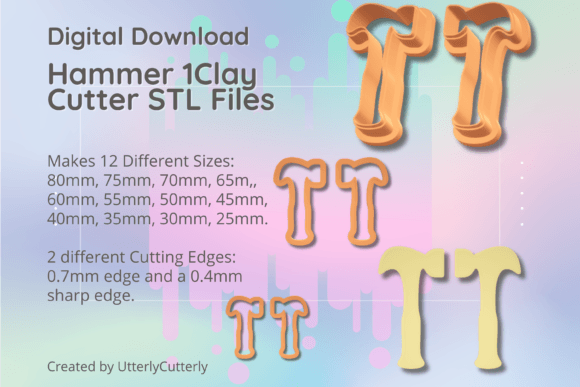
- Standard Edge (0.7mm Wall): Features a 0.7mm wall thickness with a 3mm thick base and a total height of 12mm. This variation offers structural rigidity, making it ideal for stiffer materials like cold porcelain or thicker cookie doughs where lateral pressure might deform thinner walls.
- Sharp Edge (SE): Abbreviated as SE in the file directory, this version utilizes a 1mm support wall tapering to a 0.4mm cutting edge. It shares the same 3mm base and 12mm height but is optimized for clean cuts in polymer clay and fondant. The sharper profile reduces drag and distortion during the cutting phase.
Both variations include embossing lines set at 10.5mm tall. This specific dimension is a critical workflow constraint; it dictates that your raw material must be conditioned to a thickness greater than 1.5mm to accommodate the relief detail without bottoming out. If you are working with thinner sheets, you may need to adjust your rolling process or disable the embossing feature in your slicer if the geometry allows, though using the tool as designed yields the best aesthetic integration.
Sizing Strategy and Asset Organization
Versatility in creative production often stems from having granular control over scale. The Clay Cutter STL File - Hammer 1 bundle addresses this by providing twelve discrete sizes ranging from 25mm to 80mm. These measurements refer to the longest ends of the hammer silhouette, ensuring predictable sizing when planning composite projects.
Effective digital asset management involves organizing these files logically before printing. We recommend creating a structured directory system based on size increments:
- Micro Series (25mm – 40mm): Best suited for delicate earring components, charm pendants, and intricate fondant accents. These require slower print speeds and finer layer heights (0.12mm or lower) to maintain edge definition.
- Mid-Range Series (45mm – 60mm): Ideal for barrettes, standard cookie cutters, and statement jewelry pieces. This range offers the most balanced print-time-to-utility ratio for general production.
- Macro Series (65mm – 80mm): Designed for large decorative cookies, sculptural clay elements, or oversized fashion accessories. Ensure your printer’s bed adhesion is optimized for these larger footprints to prevent warping.
Having access to this full spectrum allows creators to curate custom combos easily. When paired with other STL files from our weekly updated store, you can develop cohesive product lines that maintain proportional consistency across different motifs. This systematic approach to sizing reduces trial-and-error during the prototyping phase and streamlines inventory planning for small business owners.
Material Compatibility and Workflow Integration
The utility of the Clay Cutter STL File - Hammer 1 extends across multiple mediums, but successful implementation requires adapting your technique to the material properties. The 12mm height and reinforced 3mm base provide ample surface area for grip, which is crucial when applying even pressure across varying densities.
Polymer Clay and Jewelry Fabrication
For jewelry makers, the Sharp Edge (SE) variant is typically the superior choice. The 0.4mm cutting edge slices through conditioned polymer clay with minimal resistance, preserving crisp outlines. When integrating this tool into a jewelry workflow, consider the following process optimizations:
- Surface Prep: Use a glass tile or acrylic sheet as your work surface to ensure the cutter glides smoothly and the clay releases cleanly.
- Release Agents: While the PLA plastic used for these cutters is generally non-stick, a light dusting of cornstarch or water mist can facilitate release when working with high-tack clays.
- Post-Cut Refinement: The sharp edge minimizes cleanup, but always inspect the perimeter for micro-burrs before baking. Addressing these while the clay is raw saves significant sanding time post-cure.
Culinary Applications: Cookies and Fondant
In culinary contexts, food safety and hygiene become primary workflow considerations. While 3D printed plastics are excellent for shaping, they possess layer lines that can harbor bacteria. Professional bakers using the Standard Edge variant for cookies or fondant should implement strict sanitation protocols:
- Barrier Methods: Wrap the cutter in food-grade plastic wrap or use it exclusively for shaping dough that will be baked at temperatures sufficient to mitigate risk, avoiding direct contact with ready-to-eat items.
- Dough Consistency: Chill dough thoroughly before cutting. Warm dough adheres to 3D printed surfaces more readily than cold dough. The 0.7mm wall provides enough stiffness to cut through firm, chilled dough without flexing.
- Fondant Detailing: The 10.5mm embossing lines create professional-grade relief in rolled fondant. Ensure fondant is rolled to at least 2mm thickness to capture the full depth of the hammer texture without tearing.
Print Optimization for Durability and Precision
Achieving a functional tool requires more than default slicer settings. The geometry of the Clay Cutter STL File - Hammer 1 demands specific attention to orientation and infill to maximize lifespan and cutting performance.
Orientation: Always print the cutter standing upright on its base. Printing flat on the side creates weak layer adhesion along the cutting edge and necessitates extensive support removal that can damage the fine details. Vertical printing aligns layer lines perpendicular to the cutting force, increasing structural integrity.
Wall Count vs. Infill: Prioritize wall count over infill percentage. Set your slicer to a minimum of 3-4 perimeter walls. This ensures the cutting edge and outer shell are solid plastic, providing a smooth finish and preventing internal infill patterns from telegraphing through thin walls. Infill can remain low (10-15%) since the 3mm base and vertical walls provide adequate rigidity.
Nozzle Selection: For the Sharp Edge (SE) files, a 0.4mm nozzle is standard, but switching to a 0.25mm nozzle can significantly improve edge acuity for the smallest sizes (25mm-35mm). If using a 0.4mm nozzle, enable "thin wall detection" or "compensate wall overlaps" in your slicer to ensure the 0.4mm cutting edge is extruded consistently rather than being skipped or under-extruded.
Long-Term Maintenance and Iterative Design
Treating 3D printed cutters as consumable tools rather than permanent fixtures improves overall output quality. PLA plastic can degrade over time with exposure to moisture, UV light, and mechanical stress. Implementing a rotation schedule ensures you are always working with sharp, accurate tools.
Monitor your cutters for signs of wear:
- Edge Dulling: If cuts begin to tear rather than slice, the microscopic edge has worn down. Reprint the SE variant rather than attempting to sharpen plastic.
- Base Warping: Heat from hot glue guns, clay conditioning machines, or dishwashers can warp the 3mm base. Store cutters flat and away from heat sources to maintain planarity.
- Layer Separation: Visible gaps between layers indicate print setting issues or material degradation. Adjust retraction and temperature settings for future prints to ensure watertight seals, especially for culinary use.
The digital nature of the Clay Cutter STL File - Hammer 1 also supports iterative improvement. As new designs are added to our store weekly, you can expand your toolkit systematically. Document which sizes and edge types perform best for specific projects to build a personalized reference library. This data-driven approach to tool selection transforms random experimentation into a repeatable, scalable creative process.
By approaching this digital asset with technical mindfulness and workflow integration in mind, creators can extract maximum value from every print. Whether producing batches of artisanal cookies or crafting bespoke jewelry collections, the precision and versatility embedded in these STL files serve as reliable foundations for professional-quality output. Remember that this is a digital product; upon purchase, you gain immediate access to download the files, allowing you to begin production planning and printing without delay.