Evaluating 3D Flowers Digital Paper for Professional and Personal Creative Projects
Selecting the right digital assets requires balancing aesthetic appeal with technical specifications. When browsing for floral backgrounds, creators often encounter a wide spectrum of options ranging from flat vector patterns to photorealistic renders. 3D Flowers Digital Paper occupies a distinct niche within this landscape, offering simulated depth and texture that bridges the gap between traditional paper crafting and modern digital design. Understanding the specific characteristics of these high-resolution PNG files is essential for determining whether they align with your project requirements, particularly when comparing them against standard 2D illustrations or raw photography.
Defining the Distinction: Simulated Depth vs. Flat Design
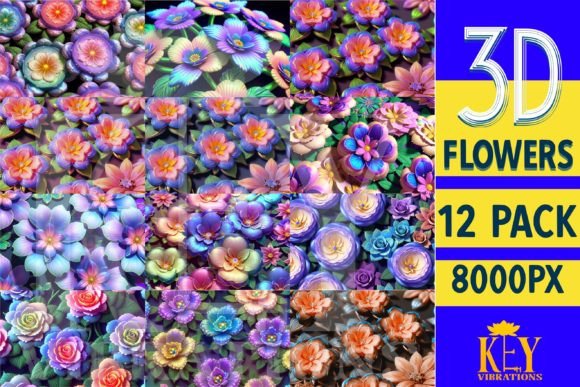
The primary differentiator of 3D flower digital paper is the rendering technique used to create the asset. Unlike traditional botanical illustration or watercolor scans which rely on shading to imply form, 3D digital papers are generated using lighting models and shadow mapping to create actual visual depth. This results in designs where petals appear to lift off the background, casting realistic shadows that change based on the virtual light source.
This distinction matters significantly for specific applications. For scrapbooking and card making, the illusion of layering saves physical time and material costs. Instead of purchasing, cutting, and assembling multiple layers of cardstock to achieve a dimensional look, a single sheet of 3D digital paper provides immediate volume. However, it is important to recognize that this is a visual simulation. If your project requires tactile interaction or genuine physical texture, digital assets cannot replace handmade paper flowers or embossed stationery. The choice depends entirely on whether the end product is visual (digital or printed) or tactile.
Resolution Considerations: 8K vs. 3K Formats
Technical specifications often dictate the viability of a digital asset for professional print work. Our collection offers 3D Flowers Digital Paper in two distinct resolution tiers: 8K at 300dpi and 3K for smaller formats. Evaluating which version to utilize prevents both file bloat and pixelation issues.
- 8K at 300dpi: This specification is designed for large-format printing and high-detail commercial projects. At 300dpi, an 8K file supports poster-sized prints without interpolation artifacts. This resolution is critical for floral home decor, wall art, or premium packaging where viewers will inspect the image closely. The higher pixel density preserves the subtle gradients in neon flowers digital paper and the delicate edges of peonies illustration styles.
- 3K Resolution: Optimized for web use, social media graphics, and small-scale stationery like greeting cards or tags. While insufficient for large banners, 3K files load faster and are easier to manipulate on devices with limited processing power. This tier is ideal for digital-only invitations or floral greeting cards intended for screen viewing.
When comparing resources, always verify the native resolution. Upscaling a low-resolution image to fit a large canvas introduces blur and noise, whereas downscaling an 8K asset maintains crispness. Choosing the appropriate starting point streamlines the workflow.
Stylistic Versatility: From Cottagecore to Neon Aesthetics
Digital floral assets are frequently categorized by style, and 3D rendering allows for versatility that traditional mediums struggle to replicate efficiently. When evaluating collections, consider how the lighting model interacts with color theory in different genres.
Romantic and Vintage Florals
In styles such as Cottagecore, Vintage Florals, and Romantic Flowers, 3D rendering focuses on soft, diffused lighting. The goal is to mimic the gentle folds of silk or the organic curvature of peonies and wildflowers. These assets serve as excellent alternatives to antique botanical scans when you require a cleaner, more uniform background for text overlay. The consistent lighting in digital 3D art eliminates the yellowing or damage often found in scanned vintage ephemera, providing a pristine yet nostalgic aesthetic suitable for wedding invitations and floral stationery.
Modern and Neon Bright Backgrounds
Conversely, Neon Flowers Digital Paper and Neon Bright Backgrounds leverage emissive materials in the 3D render engine. Traditional photography cannot easily capture bioluminescent flora without extensive post-processing or artificial props. Digital 3D art generates these glowing effects natively, making them superior for contemporary event branding, album covers, or vibrant summer flowers themes. When comparing neon options, digital 3D assets typically offer better color separation and contrast than photographed neon signs or gels, reducing the need for complex masking.
Comparative Analysis: Digital 3D vs. Physical and AI Alternatives
To make an informed decision, one must weigh 3D digital paper against other available resources in the market.
Versus Physical Paper Crafts
Paper crafts and flower sculptures offer unmatched authenticity. However, they present logistical challenges: storage, shipping costs, and the inability to instantly adjust color or scale. 3D Flowers Digital Paper eliminates these friction points. You can recolor a blue flowers background to match a specific brand palette in seconds, a task impossible with pre-dyed physical paper. The tradeoff is the loss of physical dimensionality. For hybrid projects, many designers use digital 3D paper for the base layout and add small physical accents for tactile interest.
Versus Generative AI Imagery
Generative AI tools have flooded the market with floral imagery, but consistency remains a significant hurdle. AI often struggles with anatomical accuracy in botanical art, producing petals with impossible geometry or inconsistent lighting across a series. Professionally rendered 3D digital paper ensures structural integrity and stylistic coherence. If you are designing a suite of matching items—such as floral arrangements for a full wedding stationery set—the mathematical precision of 3D modeling guarantees that every element aligns perfectly. AI is useful for ideation, but curated 3D assets provide the reliability required for production.
Versus Stock Photography
Stock photos of real flowers are abundant, but they come with fixed perspectives and lighting conditions. Isolating a specific bloom from a photograph often leaves jagged edges or color fringing. 3D Peonies Digital Paper and similar assets are typically delivered as transparent PNGs or clean compositions with intentional negative space. This makes integration into flower collage work or digital floral design significantly faster than masking stock photos. Furthermore, 3D renders avoid the legal complexities of model releases or property rights sometimes associated with garden photography.
Practical Applications and Best-Fit Scenarios
Determining when to utilize these assets involves assessing the end goal of your creative endeavor. Based on comparative evaluation, 3D Flowers Digital Paper is the optimal choice in the following scenarios:
- High-Volume Print Production: When creating hundreds of unique floral greeting cards or tags, digital assets allow for rapid variation without re-shooting or re-scanning.
- Thematic Consistency: For projects requiring specific color grading, such as pastel colors for spring or deep hues for autumn, digital files offer non-destructive editing capabilities.
- Mixed Media Foundations: Use aster digital paper or peonies graphics as a base layer in digital scrapbooking, adding digital journaling and embellishments on top without physical bulk.
- Commercial Licensing Needs: Unlike some user-generated content platforms, dedicated digital paper collections usually provide clear commercial usage terms, essential for selling floral prints or merchandise.
Conversely, consider alternative resources if your project demands extreme macro realism indistinguishable from nature, or if the audience values the imperfection of hand-drawn watercolor flowers over the polished finish of 3D rendering. Authenticity and perfection are often inversely related; knowing which attribute your audience prioritizes is key to selection.
Integration Tips for Optimal Results
To maximize the value of high-resolution 3D assets, proper handling is necessary. When working with 8K files, utilize smart objects in your editing software to preserve quality during resizing. For nature-inspired art compositions, pay attention to the virtual light source direction in the 3D paper; combining assets with conflicting lighting angles breaks the illusion of depth. Additionally, while these files are optimized for print, always perform a test strip print to verify color profiles, as neon bright backgrounds can shift significantly between RGB screens and CMYK output.
Ultimately, 3D Flowers Digital Paper serves as a versatile, high-fidelity tool for modern creators. By understanding its technical advantages regarding resolution and lighting, as well as its stylistic range from whimsical art to structured botanical patterns, you can effectively compare it against traditional and emerging alternatives. Whether enhancing spring blooms layouts or designing futuristic floral decor, these assets provide a reliable foundation for bringing artistic visions to life with precision and elegance.