Clay Cutter STL File - Moon Eclipse Comb: A Practical Guide to Digital Fabrication
The Clay Cutter STL File - Moon Eclipse Comb represents a specific intersection of digital design and tactile craftsmanship that appeals to polymer clay artists, bakers, and jewelry makers alike. This digital download bundle provides the blueprint for creating versatile tools capable of shaping everything from delicate earrings and pendants to fondant decorations and cookies. However, possessing the file is only the first step. The difference between a frustrating printing experience and a professional-grade tool often lies in understanding the technical nuances of the STL format before you ever hit "print." Many creators overlook critical specifications regarding wall thickness, cutting edge geometry, and material application, leading to broken cutters or damaged workpieces. By addressing these common oversights early, you can ensure your Moon Eclipse designs are as functional as they are aesthetically pleasing.
Selecting the Correct Cutting Edge Geometry
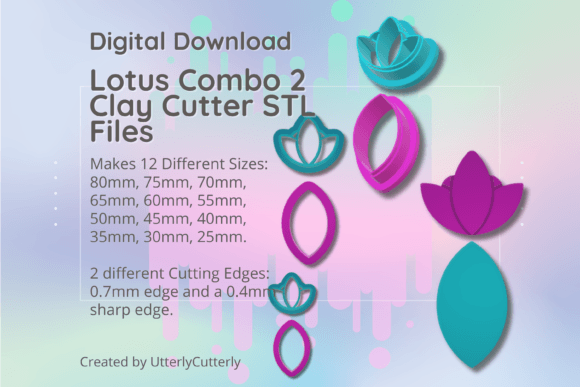
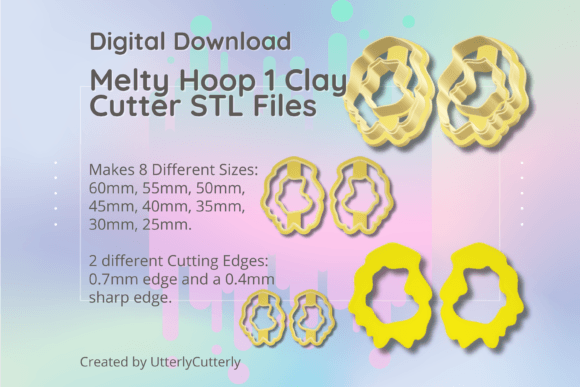
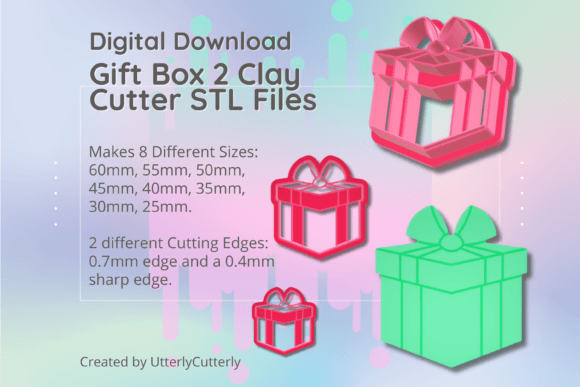
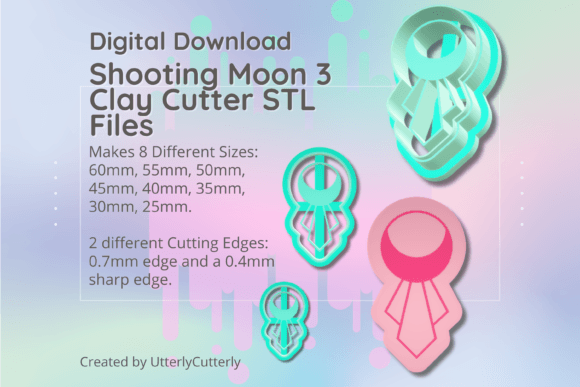
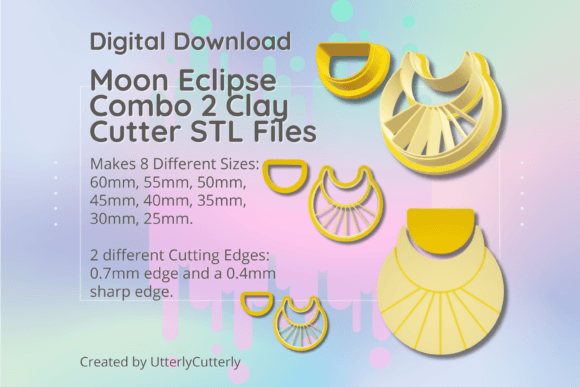
One of the most frequent mistakes users make when downloading this bundle is assuming all STL files serve the same purpose. This pack includes two distinct cutter types, and choosing the wrong one for your specific medium can ruin both the tool and your project. Understanding the distinction between the standard wall and the Sharp Edge (SE) variant is non-negotiable for quality results.
- Standard 0.7mm Wall: This version features a 0.7mm wall with a 3mm thick base and a 12mm height. It is robust and durable, making it ideal for cookie dough, stiff fondant, or thicker clay slabs where structural integrity during pressing is paramount.
- Sharp Edge (SE): Abbreviated as SE in the file names, this variant has a 1mm support wall but tapers to a precise 0.4mm cutting edge. While it shares the same 3mm base and 12mm height, its primary function is clean slicing through polymer clay without dragging or distortion.
If you attempt to use the standard 0.7mm wall cutter on soft polymer clay for intricate earring components, you will likely compress the edges rather than slice them, resulting in rounded, undefined shapes that require excessive post-processing. Conversely, using the delicate SE cutter on hard cookie dough may cause the thin 0.4mm edge to deform or snap. Always verify the file suffix matches your intended material before starting your print job.
Navigating Size Variations and Embossing Limitations
This digital bundle offers eight sizes ranging from 25mm to 60mm, measured from the longest ends. A common misunderstanding involves how these measurements translate to the final product, particularly when combining cutting with embossing. Users often assume that because the cutter is 12mm tall, they can use any thickness of clay. This is incorrect and leads to poor definition.
If your chosen STL file includes embossing lines, those details are raised to 10.5mm within the cutter's interior. For the embossing to register clearly without bottoming out or distorting the outer shape, your clay slab must be thicker than 1.5mm. Using clay that is too thin will result in the embossing feature pushing completely through the material or failing to make contact evenly. Before printing a specific size, measure your conditioned clay slab. If you typically roll clay to 1mm for lightweight earrings, select a cutter design without deep embossing or adjust your rolling technique to accommodate the 1.5mm minimum threshold required by this specific comb design.
Optimizing Print Settings for Functional Tools
Even with the correct file selected, poor printer calibration is a leading cause of cutter failure. These STL files are designed to be easily printed, but "easily" does not mean "without settings adjustment." The 0.4mm cutting edge on the SE variant, for example, requires precise extrusion control. If your flow rate is too high, the cutting edge will become blunt and uneven. If it is too low, layer adhesion will fail, and the cutter will delaminate under pressure.
For the best results with the Moon Eclipse Comb, prioritize perimeter strength over infill. Since the cutter relies on its outer walls for function, increasing wall loops (perimeters) to three or four provides far more durability than increasing infill percentage. Additionally, ensure your nozzle diameter aligns with the file specifications. Printing a 0.4mm edge with a 0.6mm nozzle is physically impossible without significant scaling artifacts. Stick to a 0.4mm nozzle for the SE files to maintain dimensional accuracy. Always print a test piece at the smallest size (25mm) to validate your settings before committing filament to the larger 60mm versions.
Material Safety and Application Boundaries
Versatility is a key selling point of this bundle, but it requires responsible material management. While the cutters are suitable for both clay and food items like cookies and fondant, cross-contamination is a serious safety risk that cannot be mitigated by washing alone. 3D printed parts have microscopic layer lines that harbor bacteria and retain chemical residues from filaments.
Never use the same physical cutter for both polymer clay and food products. Polymer clay contains plasticizers and chemicals that are not food-safe, and these can transfer to edible items even after cleaning. If you intend to use the Moon Eclipse design for both mediums, you must print separate sets. Dedicate one set exclusively to culinary use, printed in certified food-safe PLA and sealed with a food-grade epoxy if necessary, and another set for craft materials. Labeling your storage containers clearly prevents accidental misuse, which is especially important if you sell finished goods or operate in a shared studio space.
Evaluating Digital Files Before Purchase
When expanding your collection with new STL files arriving weekly, it is helpful to develop a checklist for evaluation. Beyond the aesthetic appeal of the Moon Eclipse shape, consider the practical integration with your existing workflow. Check the base thickness specification; this bundle uses a 3mm base, which provides excellent rigidity. If you own older cutters with thinner bases, mixing them in the same project might lead to inconsistent pressure application.
Furthermore, remember that this is strictly a digital download. You will not receive a physical item. Ensure you have access to a reliable 3D printer or a printing service before purchasing. Review the file list immediately upon download to confirm all eight sizes and both edge variants are present and uncorrupted. Testing the 25mm and 60mm extremes first gives you the fastest feedback loop on whether the digital assets meet your production standards. By approaching the Clay Cutter STL File - Moon Eclipse Comb with technical mindfulness rather than just creative enthusiasm, you transform a simple digital file into a dependable asset for your business or hobby.