Clay Cutter STL File - Tapered 1: Optimizing Your Digital Fabrication for Jewelry and Baking
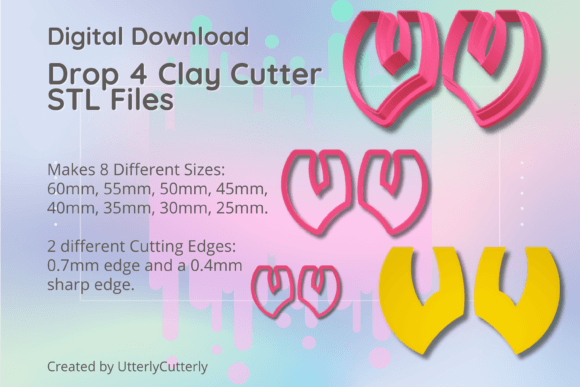
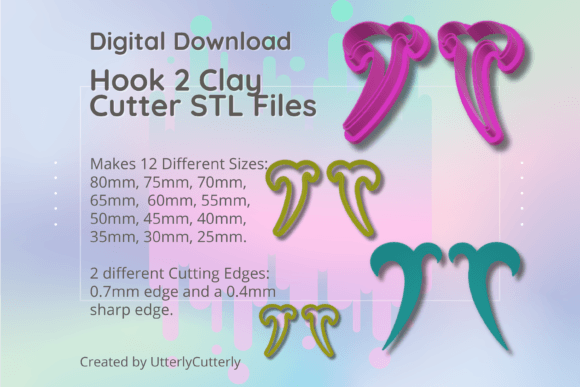
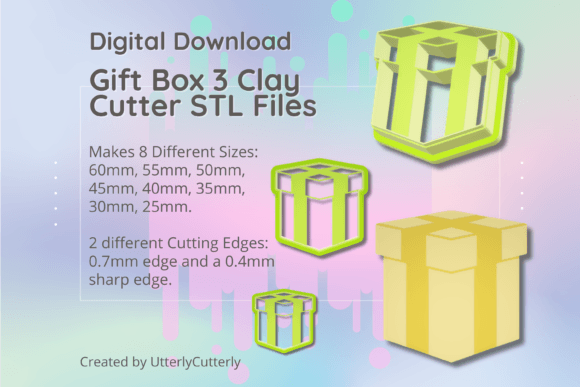
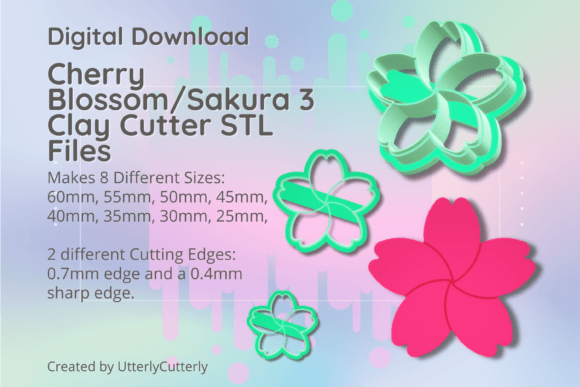
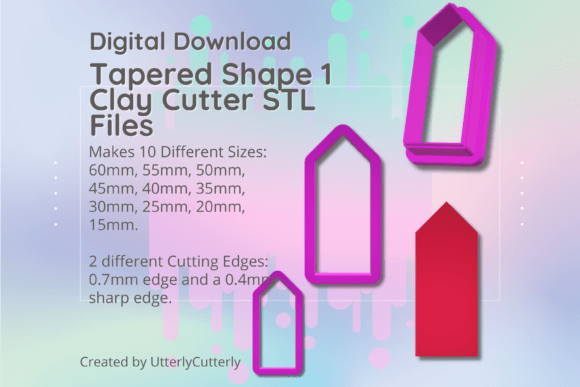
Modern geometric designs have become a staple in both polymer clay jewelry creation and artisanal baking, but achieving crisp, consistent lines often depends entirely on the quality of your tooling. The Clay Cutter STL File - Tapered 1 bundle addresses this need by providing a versatile digital asset designed specifically for makers who own 3D printers. Rather than relying on mass-produced, single-size cutters that limit creativity, this digital download empowers you to fabricate a complete suite of ten distinct sizes ranging from 15mm to 60mm. This tapered geometric shape is particularly valuable because it bridges the gap between delicate earring components and larger fondant or cookie decorations, allowing for a cohesive aesthetic across different mediums.
However, owning the STL file is only the first step. Many creators encounter frustration not because the design is flawed, but because they misunderstand how to select the correct cutter variant for their specific material. This bundle includes two distinct cutting edge profiles, and confusing them is the most common error we see. Understanding the technical differences between these profiles is essential for avoiding wasted filament, ruined clay slabs, or ragged cookie edges.
Distinguishing Between Cutting Edge Profiles
The most critical decision you will make after downloading the Clay Cutter STL File - Tapered 1 is choosing between the standard wall and the Sharp Edge (SE) variant. These are not interchangeable; they serve fundamentally different mechanical purposes.
The Standard 0.7mm Wall
This version features a 0.7mm wall thickness with a 3mm thick base and a 12mm height. A frequent mistake beginners make is assuming this cutter is suitable for all tasks. In reality, the 0.7mm wall is robust and durable, making it ideal for cookies, fondant, and thicker clays where structural integrity during the pressing motion is paramount. If you attempt to use this version for intricate polymer clay earrings, you may find the cut lacks definition, or the clay drags due to the wider surface area contacting the material. Reserve this file for applications where durability matters more than microscopic precision.
The Sharp Edge (SE) Variant
Abbreviated as SE in the file list, this version utilizes a 1mm support wall tapering down to a precise 0.4mm cutting edge. It shares the same 3mm base and 12mm height as the standard version but performs completely differently. Makers often overlook this file when working with soft polymer clay, resulting in unnecessary distortion. The SE variant is engineered specifically for jewelry making. The thinner edge slices through conditioned clay with minimal resistance, preserving the geometric taper without compressing the sides. Conversely, using the SE variant for stiff cookie dough can lead to blade deformation or breakage because the 0.4mm edge lacks the mass to withstand high-pressure forces against dense ingredients.
Sizing Strategy and Embossing Limitations
Having access to ten sizes—60mm, 55mm, 50mm, 45mm, 40mm, 35mm, 30mm, 25mm, 20mm, and 15mm—is a significant advantage, but it requires a strategic approach to sizing. A common oversight is measuring clay thickness incorrectly relative to the cutter’s internal geometry. If your chosen design includes embossing lines, note that they are exactly 10.5mm tall. This specification is non-negotiable.
If you are working with clay thinner than 1.5mm, the embossing feature will likely fail to register clearly or may punch through the material entirely. Before printing the full size range, test print a single medium-sized cutter (such as the 35mm) and measure your conditioned clay slab with calipers. Ensuring your raw material exceeds the 1.5mm threshold prevents the disappointment of muddied details. Furthermore, remember that cutter size is measured from the longest ends of the tapered shape. When planning earring layouts, account for this maximum dimension rather than averaging the width, as the taper creates visual weight that differs from circular or square cutters.
Printability and Material Considerations
These STL files are optimized for easy printing, yet print orientation and material choice still dictate success. While the 3mm thick base provides excellent bed adhesion, printing at too high a temperature can cause the tapered walls to warp slightly, altering the geometric precision. For the Sharp Edge variants especially, maintaining dimensional accuracy is vital. We recommend using PLA or PETG with adequate cooling fans enabled to ensure the 0.4mm edge solidifies instantly upon extrusion.
Another practical consideration is post-processing. Even with perfect layer settings, FDM 3D prints have layer lines. For cookie and fondant applications, this texture is generally acceptable. However, for polymer clay jewelry, those layer lines can transfer to your finished piece. Many makers skip the sanding step to save time, only to spend hours trying to smooth out ridges in their baked clay. Taking five minutes to lightly sand the cutting edge of your printed Clay Cutter STL File - Tapered 1 tool will yield professional-grade clay surfaces and reduce post-production labor significantly.
Curating a Versatile Digital Toolkit
One of the greatest benefits of digital fabrication is the ability to expand your toolkit incrementally. Because new STL files are added to the store weekly, treating this tapered pack as part of a modular system is smarter than viewing it in isolation. When curating custom combos, consider how the tapered geometry interacts with other shapes in your library. The clean lines of this modern design pair exceptionally well with organic textures or complementary geometric sets.
Avoid the trap of printing every size immediately. Instead, analyze your current project pipeline. If you are focusing on micro-earrings, prioritize the 15mm through 30mm SE files. If you are preparing for holiday baking, focus on the 45mm through 60mm standard wall files. This targeted approach saves filament and storage space while ensuring you always have the right tool ready. Remember, this is a digital download, not a physical product. You retain permanent access to these assets, allowing you to reprint replacements if a cutter breaks or to scale your production up as your skills develop.
By respecting the technical distinctions between the two edge types, adhering to material thickness requirements for embossing, and applying thoughtful post-processing, the Clay Cutter STL File - Tapered 1 becomes more than just a shape generator. It transforms into a reliable component of your creative workflow, enabling consistent, high-quality results whether you are crafting wearable art or edible decorations. Always verify your printer calibration before starting a batch, and let the precision of the digital file guide your handmade craftsmanship.