Clay Cutter STL File - Statement Flower: Evaluating Digital Designs for Jewelry and Baking
For makers utilizing 3D printing technology to produce custom tools, the Clay Cutter STL File - Statement Flower represents a specific intersection of aesthetic versatility and functional engineering. This digital asset is not merely a shape; it is a comprehensive system designed for dual-purpose application in both polymer clay jewelry making and culinary arts. When evaluating this bundle against standard single-use cutters or generic free files, the primary distinction lies in the intentional variation of cutting edges and the granular sizing options. Understanding these technical specifications is essential for determining whether this digital download aligns with your current production workflow, printer capabilities, and creative output requirements.
Dual-Edge Engineering: Comparing Sharp vs. Standard Wall Thickness
A critical decision factor when selecting STL files for clay work is the blade geometry. Many digital marketplaces offer only one iteration of a cutter design, forcing users to modify files manually if they require a different finish. The Clay Cutter STL File - Statement Flower addresses this limitation by providing two distinct cutting edge profiles within the same package. Evaluating which version to print depends entirely on the material viscosity and the desired surface finish of the final product.
The 0.7mm Standard Wall
The standard version features a 0.7mm wall thickness with a 3mm thick base and a 12mm height. This specification is engineered for durability and ease of post-processing. In practical comparison, a 0.7mm blade is significantly more robust than finer alternatives. It is less likely to warp during the printing process, especially on FDM printers without advanced cooling systems. For cookie dough or fondant, this thickness provides sufficient rigidity to cut through denser mediums without bending. However, for delicate polymer clay earrings, this edge may leave a slight bevel that requires sanding or smoothing after curing. Makers prioritizing tool longevity and multi-medium versatility often find this the superior starting point.
The Sharp Edge (SE) Variant
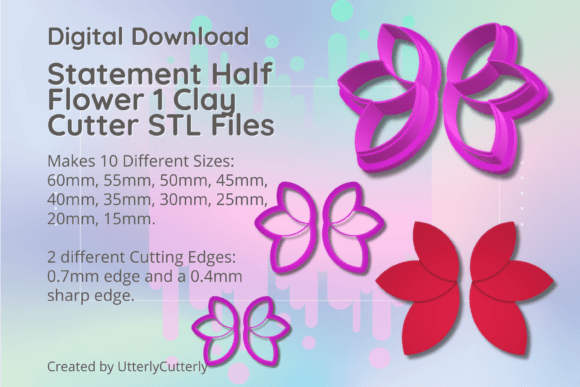
Abbreviated as SE in the file set, the Sharp Edge variant utilizes a 1mm support wall tapering to a precise 0.4mm cutting edge. While maintaining the same 3mm base and 12mm height as the standard version, the reduced contact area creates a cleaner slice through raw polymer clay. This is particularly relevant for statement flower designs where petal definition is paramount. Compared to the 0.7mm version, the SE variant reduces cleanup time significantly, preserving crisp details that might otherwise be lost to compression. The tradeoff is structural fragility; the 0.4mm tip is more susceptible to damage if dropped or used on stiff, cold clay. Users must weigh the benefit of a pristine cut against the need for careful handling and potentially shorter tool lifespan.
Sizing Strategy: Granularity vs. Standard Increments
Most commercial cutter sets operate in 5mm or 10mm increments. The Clay Cutter STL File - Statement Flower deviates from this norm by offering ten sizes ranging from 15mm to 60mm in consistent 5mm steps (15, 20, 25, 30, 35, 40, 45, 50, 55, and 60mm). This density of sizing options facilitates specific use cases that broader ranges cannot accommodate.
- Jewelry Scaling: The 15mm to 30mm range allows for creating coordinated earring and pendant sets where proportional relationships matter more than absolute size. A 25mm earring paired with a 40mm pendant maintains visual harmony better than jumping from 20mm to 50mm.
- Culinary Consistency: For cookies and fondant, having intermediate sizes like 35mm and 45mm enables bakers to maximize tray space and create tiered decorative displays without significant waste.
- Custom Curation: Because the half-flower silhouette is modular, owning the full spectrum allows makers to combine this STL pack with other geometric files to create unique composite shapes without scaling artifacts.
When comparing this bundle to adjustable vector-based cutters, fixed STL sizes offer dimensional certainty. There is no risk of aspect ratio distortion when resizing, ensuring that the statement flower’s proportions remain mathematically identical across all ten variations.
Embossing Line Considerations
An important technical note for evaluators is the embossing line height of 10.5mm. This feature is designed to work optimally with clay sheets thicker than 1.5mm. If your typical workflow involves conditioning clay to 1mm or less, the embossing lines may bottom out or fail to register clearly. Conversely, for cookie applications where dough is typically rolled to 6mm or greater, this depth ensures consistent impression without compromising structural integrity. Always verify your standard material thickness against this specification before printing the entire set.
Digital vs. Physical: Assessing Production Viability
Choosing a digital STL download over a physical product shifts the burden of quality control to the maker. While physical cutters arrive ready-to-use, the Clay Cutter STL File - Statement Flower requires an assessment of your printing infrastructure. This design is optimized for easy printing, but "easy" is relative to hardware capability.
FDM vs. Resin Printing: The 0.7mm standard walls are generally achievable on well-tuned FDM printers with 0.4mm nozzles. However, the 0.4mm Sharp Edge variant pushes the limits of FDM technology. Makers using resin printers will achieve superior results with the SE files due to higher XY resolution, though resin safety protocols for food-contact items (cookies/fondant) must be strictly observed. If you intend to use these cutters for baking and only own a resin printer, you must verify that your resin is certified food-safe and properly cured, or restrict the SE variant solely to polymer clay use.
Print Orientation and Adhesion: With a 3mm thick base, these cutters have a substantial footprint for bed adhesion. This reduces failure rates compared to thin-walled alternatives. However, the half-flower geometry means one side is straight while the other is curved. Proper orientation on the build plate is necessary to minimize supports and ensure the cutting edge remains flat. Unlike circular cutters that can be rotated arbitrarily, this asymmetric shape requires deliberate placement planning.
Decision Framework: When This Bundle Fits Your Workflow
Evaluating whether to acquire this specific digital pack involves matching its characteristics to your production needs. The Clay Cutter STL File - Statement Flower is most appropriate for makers who meet several of the following criteria:
- You require a unified aesthetic language across jewelry and edible products.
- Your printer is calibrated and capable of producing consistent 0.4mm walls (for SE variants) or you are comfortable modifying layer heights.
- You value having immediate access to ten incremental sizes rather than waiting for shipping or purchasing multiple individual packs.
- You work with clay thicknesses exceeding 1.5mm when using textured or embossed elements.
- You prefer to maintain a digital library of tools that can be reprinted if damaged, rather than accumulating physical inventory.
Conversely, alternative solutions may be preferable if you lack 3D printing hardware, require food-safe certification without personal testing, or work exclusively with very thin clay sheets under 1mm. Additionally, if your projects demand fully symmetrical flowers rather than half-flower silhouettes, this specific geometry may not serve as a standalone solution, though it excels as a complementary element in broader design systems.
Long-Term Value and File Management
Digital assets like this bundle offer compounding value through integration. As new STL files become available weekly in compatible stores, the ability to mix and match sizes becomes increasingly valuable. Maintaining organized file naming conventions—distinguishing between standard and SE variants across all ten sizes—prevents printing errors and streamlines production. Unlike physical tools that degrade over time, properly stored STL files provide indefinite utility. The initial evaluation should therefore consider not just the immediate project, but how this statement flower geometry integrates into your evolving digital fabrication ecosystem. By understanding the technical nuances of wall thickness, edge geometry, and sizing granularity, makers can make informed decisions that balance creative ambition with practical manufacturing constraints.