Clay Cutter STL File - Wiggle Petal 2: Digital Designs for Jewelry and Baking
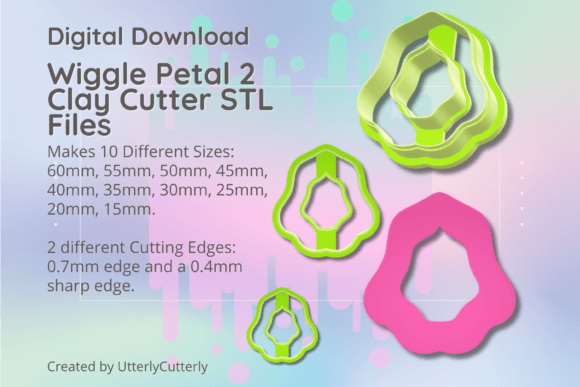
The Clay Cutter STL File - Wiggle Petal 2 represents a versatile digital asset for makers who bridge the gap between polymer clay jewelry and culinary arts. This specific digital download bundle provides immediate access to high-resolution 3D printing files designed for creating organic, flowing shapes. Unlike rigid geometric cutters, the wiggle petal design introduces movement and softness, making it an essential tool for creators focusing on botanical themes, spring collections, or fluid art styles. Because this is a digital product, you gain instant ownership of ten distinct sizes and two specialized cutting edge profiles, allowing for rapid prototyping and production without waiting for shipping.
Versatility Across Polymer Clay and Culinary Arts
One of the most significant advantages of the Wiggle Petal 2 bundle is its dual-purpose engineering. While primarily marketed toward jewelry makers, the geometry is equally effective in the kitchen. For polymer clay artists, this shape serves as a foundational element for statement earrings, layered pendants, and hair barrettes. The undulating edges catch light differently than straight lines, adding visual depth to finished pieces even before paint or glaze is applied.
In culinary applications, these same STL files translate beautifully to cookie dough and fondant. The smooth curves prevent dough from snagging during the cutting process, which is a common issue with poorly optimized 3D printed cutters. Bakers decorating wedding cakes or creating themed treats for baby showers will find the 60mm and 55mm sizes particularly useful for large fondant accents, while the smaller 20mm and 15mm variations work perfectly for intricate cookie borders or cupcake toppers. Having a single design language that spans both mediums allows mixed-media artists to maintain aesthetic consistency across different product lines.
Selecting the Right Cutting Edge for Your Material
This digital pack includes two distinct cutter types, and understanding when to use each is crucial for achieving professional results. The choice depends entirely on your material's viscosity and the level of detail required.
The Standard 0.7mm Wall Profile
The standard version features a 0.7mm wall thickness with a 3mm thick base and a 12mm height. This robust profile is the workhorse for most polymer clay projects. The thicker wall provides structural rigidity, preventing the cutter from flexing when pressing into firm clay. It creates a clean, defined edge that requires minimal post-processing. This profile is also generally safer for food use, as the thicker walls are less likely to harbor bacteria and are easier to sanitize thoroughly. If you are working with air-dry clay or softer cookie doughs, start here to ensure the cutter maintains its shape over repeated uses.
The Sharp Edge (SE) Profile
Abbreviated as SE in the file names, the Sharp Edge variant features a 1mm support wall tapering to a precise 0.4mm cutting edge. This profile is engineered for detailed work and harder materials. When slicing through conditioned polymer clay, the SE profile reduces drag and distortion, preserving the delicate wiggle texture of the petal. However, because the cutting edge is finer, it requires a lighter touch. This profile excels at creating crisp edges for earrings where sanding time needs to be minimized. Note that while sharper, the 0.4mm edge may require more careful handling and cleaning if used with sticky food products.
Sizing Strategy for Cohesive Collections
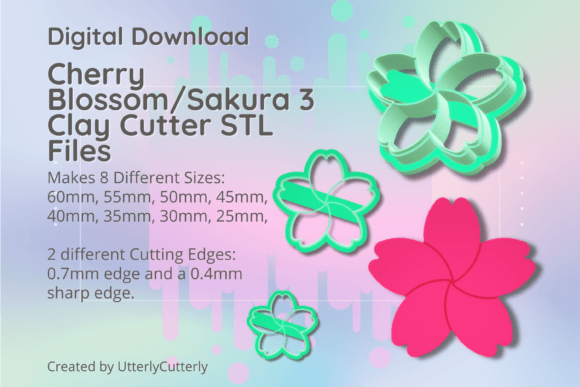
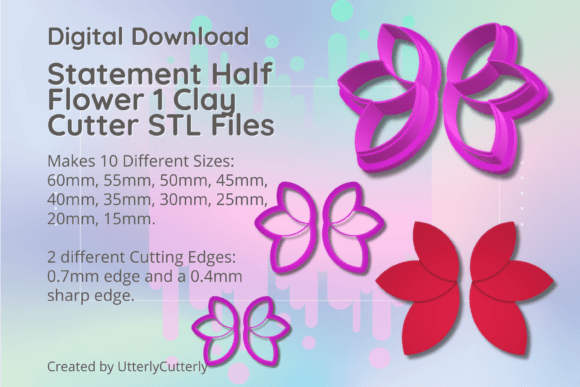
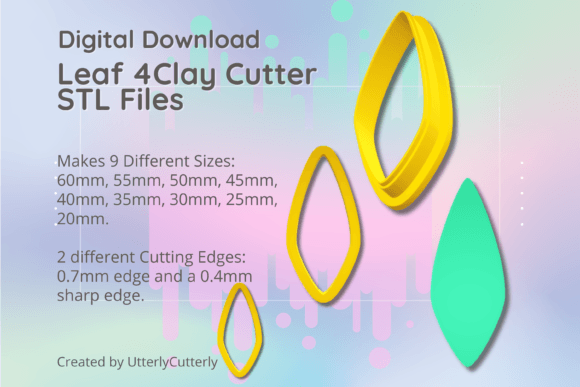
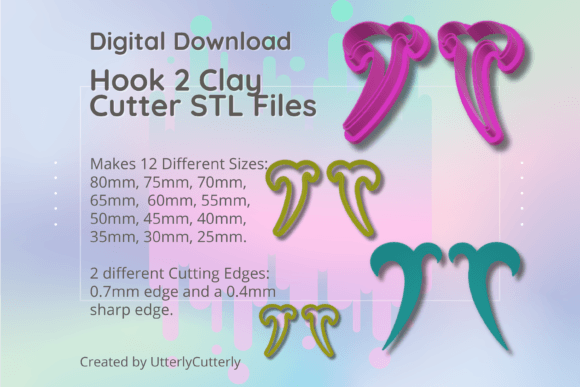
The inclusion of ten graduated sizes—from 15mm up to 60mm—enables creators to build cohesive product ecosystems rather than isolated items. Measurements are taken from the longest ends of the cutter, ensuring accurate scaling for your designs.
- 60mm – 45mm: Ideal for statement necklaces, large barrettes, cake toppers, and primary cookie shapes.
- 40mm – 30mm: The sweet spot for standard stud earrings, pendant layers, and medium-sized fondant decorations.
- 25mm – 15mm: Perfect for dainty jewelry, charm bracelets, cookie accents, and micro-details on larger clay sculptures.
Having this full spectrum available in one download eliminates the guesswork of scaling files in slicer software, which can sometimes distort aspect ratios. You can confidently curate custom combos, pairing a 50mm base layer with a 30mm top layer for dimensional jewelry, or nesting multiple sizes to create floral wreath cookies. This scalability also future-proofs your purchase; as trends shift toward miniaturization or maximalism, you already have the appropriate tooling ready to print.
Technical Considerations for Embossing and Printing
For makers utilizing embossing features within their workflow, pay close attention to the vertical tolerances. Any embossing lines included in these designs stand 10.5mm tall. To achieve a clear impression without bottoming out, your clay slab must be thicker than 1.5mm. Attempting to emboss into thinner sheets will result in muddy details or structural failure of the clay. Always condition your clay to a consistent thickness slightly exceeding this minimum threshold before applying pressure.
When printing these STL files, orientation matters. Print the cutters with the cutting edge facing up to avoid support structures touching the functional surface. A standard 0.4mm nozzle with 20-30% infill provides sufficient strength without wasting filament. Since these are designed for easy printing, they typically do not require advanced slicer settings, but using a brim can help prevent warping on the larger 60mm and 55mm sizes. Always verify your printer’s calibration; even a 0.1mm deviation can affect how cleanly the sharp edge slices through clay.
Maximizing Value Through Digital Flexibility
Purchasing the Clay Cutter STL File - Wiggle Petal 2 as a digital download offers logistical benefits beyond immediate access. Physical cutters wear down, break, or get lost. With the STL files, you can reprint replacements indefinitely. This is particularly valuable for small business owners who may need multiple identical cutters to streamline assembly-line production during peak seasons like holidays or market prep.
Furthermore, owning the digital file grants you the freedom to experiment with different filaments. Food-safe PLA is excellent for baking, while PETG or ABS might offer better durability for heavy-duty polymer clay use. You can also color-code your cutters by printing different sizes in different filament colors, creating an intuitive organizational system in your studio. As new STL files are added to the store weekly, this wiggle petal design can serve as a modular component in an ever-expanding library, allowing you to mix and match organic shapes with future releases to develop a signature style that evolves with your craft.
Practical Workflow Integration
Integrating these cutters into your existing workflow requires mindful material management. Because the wiggle petal shape has varying curve radii, releasing the clay cleanly sometimes requires a specific technique. For polymer clay, chilling the slab briefly before cutting helps the material release from the 0.7mm or SE walls without stretching. For cookies, a quick dip in flour or powdered sugar acts as a release agent specifically suited to the undulating edges.
Remember that this is strictly a digital item. There is no physical product shipped. Upon purchase, you receive the files necessary to manufacture the tools yourself. This distinction is important for planning; ensure you have access to a functioning 3D printer and appropriate filament before starting a time-sensitive project. However, for those equipped with printing capabilities, the autonomy to produce, modify, and replace tools on demand makes this digital bundle a cornerstone resource for sustainable and scalable making.