Heptagon Septagon 2 Clay Cutter: Digital STL Files
The seven-sided polygon occupies a unique space in geometric design. It is complex enough to be visually arresting yet balanced enough to serve as a foundational shape for jewelry and culinary arts. The Heptagon Septagon 2 Clay Cutter digital download provides creators with immediate access to this versatile form through high-quality STL files. Rather than relying on generic, mass-produced tools, this bundle allows makers with 3D printers to fabricate their own precision instruments tailored to specific project requirements. With eight distinct sizes and two specialized cutting edge profiles, this digital asset bridges the gap between mathematical geometry and tangible craftsmanship.
Understanding the Technical Specifications
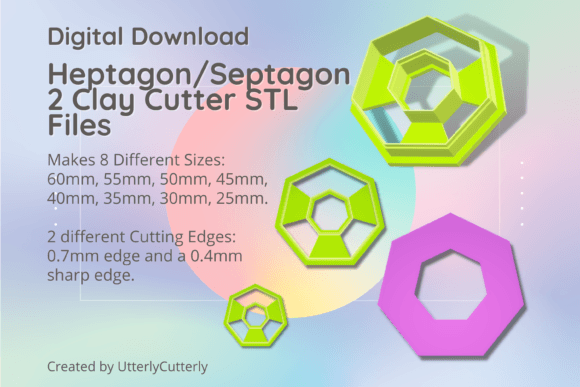
Successful clay work and fondant shaping depend entirely on tool precision. This STL pack is engineered to eliminate guesswork during the printing and creation process. The bundle includes eight graduated sizes measured from the longest ends: 60mm, 55mm, 50mm, 45mm, 40mm, 35mm, 30mm, and 25mm. This comprehensive range ensures that whether you are crafting delicate earring components or substantial pendant bases, you have the exact dimension required without needing to scale files manually, which can sometimes compromise wall integrity.
The true value of this digital download lies in the dual cutter types included in the package. Makers can choose between two distinct profiles based on the material being used and the desired finish:
- Standard Wall (0.7mm): This cutter features a 0.7mm wall thickness with a 3mm thick base and a total height of 12mm. It offers durability and rigidity, making it ideal for firmer polymer clays or repeated use in production environments where tool longevity is prioritized over an razor-thin slice.
- Sharp Edge (SE): Abbreviated as SE in the file names, this variant features a 1mm support wall tapering to a precise 0.4mm cutting edge. Like the standard version, it maintains a 3mm thick base and 12mm height. The sharper profile is designed for clean cuts in softer materials like fondant, gum paste, or conditioned polymer clay, reducing drag and deformation.
For projects requiring texture or depth, any embossing lines integrated into the design stand 10.5mm tall. This specific measurement is intentional; it requires clay to be rolled thicker than 1.5mm to capture the full detail without bottoming out. All files undergo rigorous testing before release, ensuring that the digital geometry translates accurately to physical objects.
Applications in Jewelry Design
The heptagon shape challenges the conventional symmetry of circles and squares in wearable art. For jewelry designers, the Heptagon Septagon 2 Clay Cutter serves as a starting point for collections that feel modern and architectural. The 25mm and 30mm sizes are particularly effective for creating lightweight statement earrings. Because the shape has seven sides, it creates natural focal points that differ depending on how the piece is oriented, allowing for dynamic movement in dangling designs.
Larger sizes, such as the 50mm and 60mm cutters, open possibilities for bold pendants and brooches. When working with polymer clay, the Sharp Edge (SE) variant is often superior for these larger formats. A cleaner cut reduces the amount of post-processing sanding required, preserving the crisp geometric lines that define the aesthetic. Designers can also utilize the size gradation to create nested sets or ombré color transitions within a single collection. By curating custom combos with other STL files from the store, makers can build a cohesive brand identity that relies on consistent, professional-grade shapes rather than improvised hand-cutting.
Culinary Creativity and Fondant Work
Beyond jewelry, geometric cutters are essential tools for modern pastry chefs and cake decorators. The heptagon offers a sophisticated alternative to standard cookie shapes, particularly for themed events involving mathematics, architecture, or abstract art. When working with edible mediums, food safety and material performance are paramount. Users must ensure they print these STL files using food-safe filaments and adhere to strict hygiene protocols, as 3D printed layers can harbor bacteria if not properly sealed or used with appropriate barriers.
For fondant and gum paste decorations, the 0.7mm wall cutter often provides better structural support when lifting the shape from the work surface. The slightly thicker wall prevents the fondant from warping during the transfer to the cake. Conversely, when cutting shortbread or sugar cookies, the Sharp Edge variant helps maintain the definition of the seven sides during baking. Dough tends to spread; a sharper initial cut compensates for this expansion, resulting in a finished cookie that retains its geometric integrity. The 40mm to 60mm range is ideal for individual plated desserts or cupcake toppers, while smaller sizes can be used for intricate mosaic patterns on celebration cakes.
Optimizing Your 3D Printing Workflow
Having the digital file is only the first step; achieving a functional tool requires proper printer calibration. Because these cutters feature thin walls and precise edges, print orientation matters significantly. Printing the cutter with the cutting edge facing up (base on the build plate) is generally recommended to avoid the need for supports on the functional surfaces. Supports on cutting edges require removal and sanding, which can ruin the precision of the 0.4mm SE blade.
Material selection should align with the intended application. PLA is sufficient for most polymer clay and fondant work due to its stiffness and ease of printing. However, for users planning to wash cutters frequently or use them with warmer materials, PETG or ABS may offer better thermal resistance and durability. Layer height should be kept low, ideally 0.12mm or 0.16mm, to ensure the top surface of the 3mm base is smooth and does not imprint layer lines onto the clay. Always verify your printer’s flow rate and extrusion multiplier before printing the entire set; over-extrusion can close off the thinner SE cutting edges, rendering them ineffective.
Building a Versatile Creator Toolkit
Digital downloads like the Heptagon Septagon 2 Clay Cutter represent a shift toward sustainable, on-demand manufacturing for small businesses and hobbyists. Instead of storing bulky physical inventory, creators maintain a library of STL files that can be printed as needed. This approach allows for rapid prototyping and iteration. If a client requests a specific size adjustment or a variation on the theme, the digital nature of the tool makes adaptation feasible.
New STL files are added to the store weekly, encouraging makers to continuously expand their repertoire. Building a diverse collection of geometric cutters enables creators to respond quickly to trends without significant upfront investment. Whether you are an educator teaching geometry through tactile arts, a freelancer developing a new product line, or a hobbyist exploring form, these digital assets provide the technical foundation necessary for high-quality output. By understanding the specific attributes of each cutter type and size, users can move beyond simple shape-cutting to develop refined, professional creative practices that stand out in a saturated market.
Please be aware that you are responsible for verifying the suitability of materials and printing parameters for your specific use case. While our cutters are tested for performance, end-user safety and application compliance remain the responsibility of the maker.