Mastering Polymer Clay and Baking with the Moon and Cloud 1 STL Cutter Bundle
In the evolving world of handmade crafts, the intersection of digital technology and traditional artistry has opened up unprecedented avenues for creativity. For makers, jewelry designers, and bakers, the ability to customize tools is just as important as the materials themselves. The Moon and Cloud 1 Clay Cutter digital download represents a significant shift in how creators approach their work. Rather than relying on mass-produced, generic shapes, this STL file bundle empowers you to print your own precision tools tailored specifically for earrings, pendants, barrettes, cookies, and fondant decorations.
Understanding the nuances of this digital asset is essential for maximizing its potential. This guide explores the technical specifications, practical applications, and creative advantages of using a versatile, multi-size cutter set designed for both polymer clay and culinary arts. Whether you are a beginner setting up your first 3D printer or an experienced artisan looking to expand your inventory, grasping the details of these files will elevate the quality and consistency of your finished products.
The Versatility of Digital Fabrication in Craft
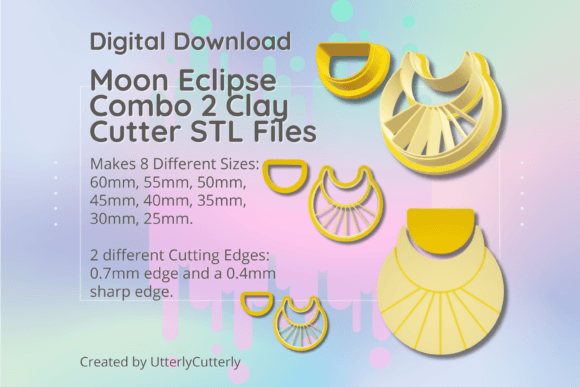
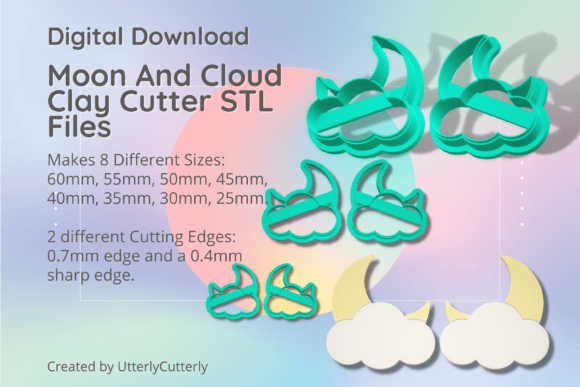
The primary significance of purchasing an STL file bundle like the Moon and Cloud 1 pack lies in autonomy. In traditional crafting, if a specific cutter size does not exist commercially, the project often hits a roadblock. With digital fabrication, that barrier disappears. This specific bundle includes eight distinct sizes ranging from 25mm to 60mm, allowing for a graduated aesthetic that is highly sought after in modern jewelry design and tiered cake decorating.
This versatility extends beyond mere sizing. The design philosophy behind these cutters acknowledges that different projects require different blade geometries. By providing two distinct cutting edge types within the same digital package, the designer ensures that the tool serves multiple mediums effectively. This adaptability fits seamlessly into modern small business models where product lines frequently shift between seasons, trends, and customer requests. Instead of storing dozens of physical plastic cutters that may degrade over time, you possess a permanent digital library that can be reprinted, modified, or shared across multiple printers as your business scales.
Understanding Cutter Geometry: Sharp Edge vs. Standard Wall
One of the most critical aspects of working with 3D printed cutters is understanding the difference between blade types. Not all clay or dough behaves the same way, and using the wrong geometry can lead to tearing, sticking, or undefined edges. The Moon and Cloud 1 bundle addresses this by offering two specialized variations.
The Standard 0.7mm Wall
The standard version features a 0.7mm wall thickness with a 3mm thick base and a total height of 12mm. This geometry is robust and durable. It is generally recommended for:
- Softer Clays: Materials like Sculpey III or softer fondant that might deform under extreme pressure benefit from the slightly wider surface area of the 0.7mm wall.
- Durability: If you are printing in standard PLA and anticipate heavy use, the thicker wall reduces the risk of the cutter snapping during demolding.
- Beginners: Those new to 3D printing may find the 0.7mm wall more forgiving regarding layer adhesion and nozzle calibration.
The Sharp Edge (SE) Variation
Abbreviated as "SE" in the file names, the Sharp Edge variation maintains the same 3mm base and 12mm height but utilizes a 1mm support wall tapering to a 0.4mm cutting edge. This is a game-changer for professional-grade finishes.
- Clean Cuts: The thinner edge slices through firmer polymer clays (like Cernit or Fimo Professional) and rolled cookie dough with minimal resistance, reducing drag marks.
- Detail Preservation: For intricate moon and cloud designs, a sharper edge captures internal corners more accurately than a blunt wall.
- Reduced Cleanup: Because the cut is cleaner, there is significantly less sanding or trimming required post-bake, saving hours of labor in production workflows.
Sizing Strategy for Jewelry and Confectionery
The inclusion of eight specific sizes—60mm, 55mm, 50mm, 45mm, 40mm, 35mm, 30mm, and 25mm—is not arbitrary. In design theory, having incremental sizing allows for the creation of cohesive collections. When curating custom combos, consider how these measurements translate to real-world applications.
For earring making, the 25mm to 35mm range is typically ideal for studs and petite dangles, while the 40mm to 50mm sizes serve as statement pieces. The larger 55mm and 60mm cutters are perfect for pendant necklaces, hair barrettes, or keychains. It is important to note that cutter size is measured from the longest ends; always account for the visual weight of the shape, as a crescent moon at 40mm may appear visually smaller than a solid circle of the same dimension due to negative space.
In culinary applications, this size gradient facilitates tiered decoration. A baker might use the 60mm cutter for large fondant accents on a wedding cake, stepping down to 30mm and 25mm for cupcake toppers or cookie borders. Having the exact STL files means you can reprint a specific size instantly if one goes missing or breaks during a busy holiday season, ensuring continuity in your product line.
Technical Considerations for Embossing and Printing
A unique feature of this digital bundle is the integration of embossing capabilities. However, users must understand the relationship between cutter height and clay thickness to avoid frustration. The embossing lines in these files are 10.5mm tall. Given that the total cutter height is 12mm, this leaves a precise tolerance window.
Crucial Guideline: You must work with clay or dough that is thicker than 1.5mm. If your material is thinner than this threshold, the embossing detail will either fail to register clearly or, worse, cut completely through the material unintentionally. For optimal results with the embossed versions, conditioning your polymer clay to a consistent 2mm–3mm thickness ensures the design presses in beautifully without compromising the structural integrity of the piece.
Regarding 3D printing, these files are optimized for ease of fabrication. The 3mm base provides ample surface area for bed adhesion, reducing warping. However, because the SE files contain thin features, proper cooling and flow rate calibration are essential. Always print a test cutter before committing to a full batch to ensure your printer’s tolerances match the digital specifications.
Quality Assurance and Safety in Maker Tools
When sourcing digital manufacturing files, trust is paramount. All cutters in this bundle undergo testing as part of a standard quality checking system before being listed. This E-E-A-T (Experience, Expertise, Authoritativeness, and Trustworthiness) principle ensures that the STL files you download have been validated for functionality, not just theoretical geometry.
However, users should be aware of safety best practices when using 3D printed items with food or skin-contact materials. While PLA is generally considered food-safe in its raw form, the layer lines created during FDM printing can harbor bacteria. For cookie and fondant use, it is highly recommended to seal your printed cutters with a food-safe epoxy resin or use them exclusively with a barrier like plastic wrap. For polymer clay, dedicated cutters prevent cross-contamination. Furthermore, because these are digital downloads, new STL files are added to the store weekly, allowing your tool library to grow alongside emerging trends without additional shipping waste or storage costs.
Building a Sustainable Creative Workflow
Ultimately, the Moon and Cloud 1 Clay Cutter bundle is more than just a set of shapes; it is a foundational element of a sustainable, scalable creative practice. By mastering the differences between the 0.7mm and Sharp Edge variations, respecting the dimensional requirements for embossing, and leveraging the eight-size gradient, makers can produce professional, consistent results across diverse mediums.
This digital-first approach reduces reliance on supply chains, minimizes plastic waste through on-demand printing, and grants artists complete control over their toolkit. Whether you are crafting delicate lunar-themed jewelry for an autumn collection or baking celestial treats for a themed event, these STL files provide the precision and flexibility needed to bring your vision to life. As you integrate these tools into your workflow, remember that the quality of your output is directly linked to your understanding of the tool's design—print wisely, test thoroughly, and create boldly.