Clay Cutter STL File - Drop 4: Optimizing Your Digital Fabrication Workflow
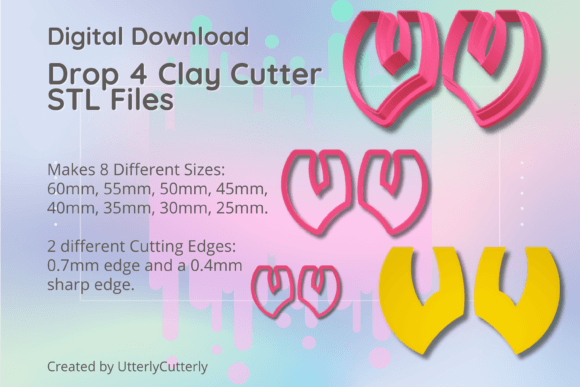
Acquiring the Clay Cutter STL File - Drop 4 is often the first step in streamlining a jewelry or confectionery production line, but simply downloading the file does not guarantee professional results. This digital asset represents a versatile drop shape design intended for polymer clay earrings, pendants, barrettes, cookies, and fondant decorations. However, many creators overlook the critical technical distinctions within this specific bundle, leading to print failures or unusable tools. Understanding the nuances between the two included cutting edge profiles and the eight available sizes is essential for maximizing the utility of this digital download.
The primary value of this pack lies in its adaptability. With sizes ranging from 25mm to 60mm, it supports everything from delicate stud earrings to substantial statement pieces or baked goods. Yet, the most common mistake occurs during the selection phase before printing even begins. Users frequently assume all STL files in a bundle are identical except for scale. In reality, this pack contains two distinct cutter types that serve fundamentally different purposes. Confusing these can result in wasted filament, damaged clay, or frustration when the tool does not perform as expected for your specific medium.
Distinguishing Between Cutting Edge Profiles
A frequent oversight among both beginners and experienced makers is failing to match the cutter type to the material density and desired finish. The Clay Cutter STL File - Drop 4 includes two specific variations that must be chosen intentionally rather than arbitrarily.
- Standard 0.7mm Wall: This version features a 0.7mm wall thickness with a 3mm thick base and a 12mm height. It is designed for durability and general-purpose use. If you are working with firmer polymer clays, cookie dough, or fondant, this is typically the safer choice. The thicker wall resists bending under pressure, ensuring the drop shape maintains its geometry during repeated use.
- Sharp Edge (SE): Abbreviated as SE in the file names, this variant has a 1mm support wall but tapers to a precise 0.4mm cutting edge. While it offers superior definition for intricate details, it requires careful handling. Many users mistakenly print the SE version for heavy-duty tasks, only to find the thin edge deforms or breaks. Reserve this profile for softer clays where a clean, crisp slice is prioritized over structural brute force.
Selecting the wrong profile affects more than just longevity; it impacts the quality of your final product. Using a standard cutter on soft clay can drag and distort edges, while using an SE cutter on stiff dough may cause the blade to splay. Always verify the file name suffix before slicing to ensure alignment with your current project requirements.
Sizing Strategy and Measurement Accuracy
Another area where efficiency is often lost involves misunderstanding how these cutters are measured. The size specification—whether 25mm, 30mm, 35mm, 40mm, 45mm, 50mm, 55mm, or 60mm—is measured from the longest ends of the drop shape. A common error is assuming this measurement represents the width at the widest point or the total bounding box dimensions. This misconception leads to scaling issues when trying to coordinate earring pairs or fit components into pre-designed metal settings.
Before committing to a full print run, measure your target hardware or packaging against the actual longest dimension of the digital model. Because this is a digital download, you have the advantage of verification in your slicer software. Use the measurement tool in Cura, PrusaSlicer, or Bambu Studio to confirm the Z-height and XY footprint match your needs. Relying on thumbnail images or file names alone without digital verification is a preventable error that costs time and materials.
Managing Embossing Lines and Clay Thickness
For creators utilizing the embossing features potentially included in related designs or future updates, understanding vertical tolerances is non-negotiable. If embossing lines are present, they are typically set at 10.5mm tall. This specification dictates a minimum clay thickness of 1.5mm to function correctly. Attempting to use these cutters with clay rolled thinner than this threshold will result in the embosser hitting the work surface, damaging both the tool and your rolling mat.
This interaction highlights why reading technical specifications matters more than aesthetic appeal. If your standard workflow involves rolling clay to 1mm, this specific cutter configuration will not yield the intended textured effect. Adjust your slab roller settings or choose a different tool from our expanding library that matches your preferred thickness. Our store adds new STL files weekly, so finding a compatible alternative is always an option if this specific drop design conflicts with your established production parameters.
Printability and Slicing Considerations
While our cutters are designed to be easily printed, "easy" does not mean "automatic." Poor layer adhesion is the silent killer of clay cutter functionality. Even with the robust 3mm thick base and 12mm height specified in this pack, insufficient cooling or improper bed adhesion can create weak points. For the Sharp Edge variants especially, ensure your printer’s cooling fan is optimized to solidify the thin 0.4mm tip rapidly. Without adequate cooling, the fine edge can slump, rendering the cutter useless for precision work.
Additionally, consider your nozzle diameter. Printing a 0.7mm wall with a 0.6mm nozzle leaves almost no margin for error and may result in gaps. A 0.4mm nozzle is generally recommended for these files to ensure proper wall line counts and structural integrity. Checking your hardware compatibility before starting the print prevents the disappointment of fragile tools that fail during their first use.
Digital Asset Management and Expectations
Finally, remember that this is strictly a digital product. There is no physical item shipped to your door. Access to the files is immediate upon purchase completion, but this also means quality control rests entirely on your equipment and settings. Before buying, verify that your 3D printer is calibrated and capable of handling the tolerances described. If you are new to printing functional tools, start with the standard 0.7mm wall version in a mid-range size like 40mm to test your system’s capabilities before attempting the more demanding Sharp Edge profiles.
By approaching the Clay Cutter STL File - Drop 4 with technical awareness rather than assumption, you transform a simple digital file into a reliable production asset. Whether you are curating custom earring collections or decorating cookies, respecting the design parameters ensures consistent, professional outcomes. Explore the full range of sizes and types available, and leverage the versatility of this bundle to enhance your creative offerings efficiently.