Clay Cutter STL File - Leaf 5: Digital Design Specifications and Practical Application
The Clay Cutter STL File - Leaf 5 represents a specific category of digital fabrication assets designed for creators who require precision tools for polymer clay, cookie dough, and fondant work. Unlike generic shape files, this digital download is engineered with manufacturing constraints in mind, offering a bundle that addresses the varying needs of jewelry makers and culinary artists simultaneously. For professionals and serious hobbyists operating 3D printers, the value of such a file lies not merely in the aesthetic of the statement leaf shape, but in the technical versatility embedded within the design parameters. This asset provides a comprehensive solution for producing custom cutters without the lead time or expense associated with commercial molding services.
Technical Variations and Printability
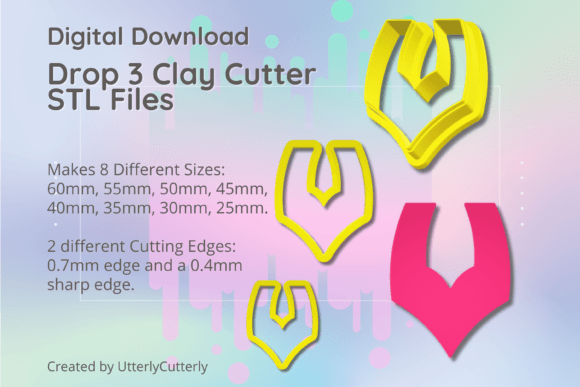
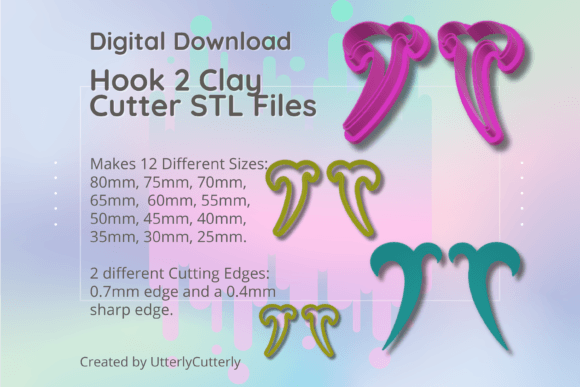
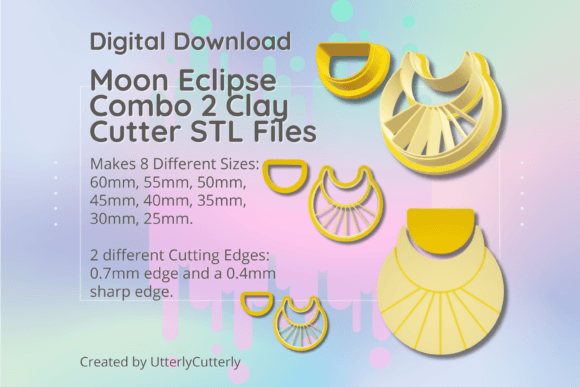
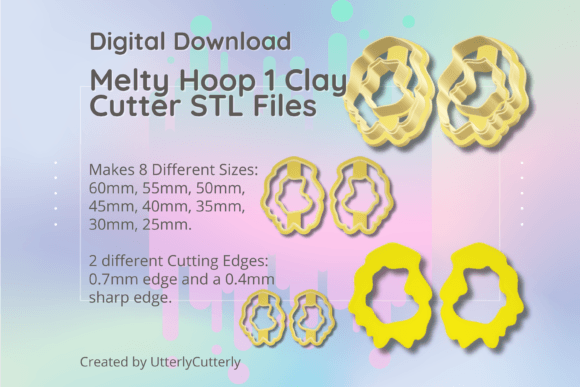
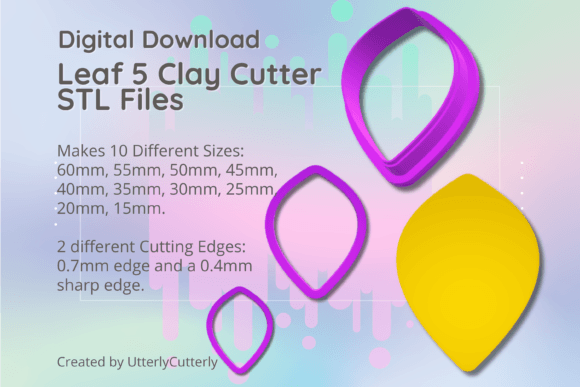
A critical distinction in this STL pack is the inclusion of two distinct cutting edge profiles. Understanding the difference between these variations is essential for selecting the appropriate tool for your specific medium. The pack includes a standard 0.7mm wall thickness option and a specialized Sharp Edge (SE) variant. The standard cutter features a 0.7mm wall, a 3mm thick base, and a total height of 12mm. This configuration offers structural rigidity suitable for stiffer materials like cold porcelain or thicker cookie doughs where durability takes precedence over extreme sharpness.
Conversely, the Sharp Edge files, abbreviated as SE in the directory, utilize a 1mm support wall tapering to a precise 0.4mm cutting edge. While maintaining the same 3mm base and 12mm height as the standard version, this geometry is optimized for polymer clay and fondant. The reduced contact surface at the cutting point ensures cleaner slices with less material displacement, reducing the need for post-processing or sanding. However, users should note that the SE variant requires careful print orientation and potentially finer nozzle settings to achieve the intended 0.4mm edge fidelity. Both designs are structured for easy printing, minimizing the need for excessive supports if oriented correctly on the build plate.
Dimensional Range and Workflow Integration
Versatility in scale is often the limiting factor in digital cutter libraries. This bundle mitigates that issue by providing ten discrete sizes ranging from 15mm to 60mm. The sizing is measured from the longest ends of the leaf silhouette, ensuring predictable scaling across the set. The available increments are:
- 60mm and 55mm: Suitable for large pendants, barrettes, or statement cookies.
- 50mm, 45mm, and 40mm: Ideal for standard earrings and medium-sized fondant decorations.
- 35mm, 30mm, and 25mm: Appropriate for smaller jewelry components and detailed cake accents.
- 20mm and 15mm: Designed for miniature charms, stud earrings, or intricate border work.
This granular size progression allows creators to curate custom combinations without resorting to arbitrary scaling in slicer software, which can distort wall thicknesses and compromise print integrity. By using pre-calculated sizes, users maintain the engineered 3mm base thickness and correct cutting edge ratios regardless of the selected dimension. This consistency is vital for professionals who need to reproduce identical results across multiple production runs or create cohesive collections where proportion matters as much as individual detail.
Material Compatibility and Embossing Considerations
While the primary function of the Clay Cutter STL File - Leaf 5 is cutting, the design also accounts for embossing functionality. Any embossing lines integrated into the model are set to a height of 10.5mm. Given the total cutter height of 12mm, this leaves a 1.5mm clearance. This specification serves as a practical gauge for material preparation; users must ensure their clay or dough is rolled to a thickness greater than 1.5mm to fully engage the embossing detail without bottoming out. If the material is too thin, the cutter may slice through before the texture transfers effectively.
This dual-purpose capability extends the utility of the file beyond simple outline creation. For jewelry makers, it enables the production of textured leaf components that mimic natural veins or stylized patterns in a single pass. For bakers, it facilitates decorated cookies that do not require separate stamping tools. However, operators should be aware that embossing increases friction during the cutting process. When working with sticky media like fondant, chilling the material or using a release agent becomes more important when utilizing the textured variants compared to the plain cutting edges.
Evaluating Long-Term Value and Usability
From a resource management perspective, acquiring a digital bundle offers distinct advantages over physical inventory. The immediate access to the Clay Cutter STL File - Leaf 5 eliminates shipping delays, allowing for rapid prototyping and iteration. If a specific size proves unsuitable for a project, an alternative can be printed within hours rather than days. Furthermore, digital files do not degrade, warp, or break. Physical plastic cutters eventually wear down or snap under pressure, whereas the STL file serves as a master template from which unlimited replacements can be manufactured.
The usability of this asset also depends heavily on the user's 3D printing proficiency. While the files are described as easily printed, achieving the 0.4mm sharp edge requires a well-tuned machine. Users with entry-level printers or those unfamiliar with fine-detail calibration may find the SE variant challenging. In such cases, the 0.7mm standard version provides a reliable fallback that sacrifices minimal performance for significantly higher print success rates. This built-in redundancy makes the pack accessible to a broader range of skill levels while still catering to advanced users seeking maximum precision.
Target Audience and Professional Application
This digital asset is most relevant to three distinct user groups. First, independent jewelry designers who work with polymer clay will benefit from the SE variant and smaller sizes for creating lightweight, detailed components. The ability to print custom sizes supports small-batch production and bespoke commissions without minimum order quantities. Second, cottage food businesses and bakers can utilize the larger sizes and standard edge for consistent product presentation. The food-safe nature of the final tool depends entirely on the filament chosen, but the geometry itself is appropriate for culinary use. Third, educators and workshop leaders can leverage the full size range to teach scaling, proportion, and tool fabrication as part of a broader maker curriculum.
For marketers and content creators in the craft niche, the statement leaf design aligns with current trends in botanical aesthetics and sustainable fashion. Having the ability to produce proprietary tools allows for unique product differentiation in saturated markets. Rather than selling the same commercially available leaf shapes as competitors, creators can establish a distinct visual identity through custom-manufactured tools derived from this STL pack.
Practical Recommendations for Implementation
To maximize the effectiveness of the Clay Cutter STL File - Leaf 5, users should adopt a systematic approach to file management and testing. Before committing to a full production run, print one test cutter in the SE variant and one in the standard variant using your preferred filament. Evaluate the edge quality under magnification and test cut performance on your specific medium. Document the optimal slicer settings for future reference. Additionally, because this is a digital download and not a physical item, organize the files immediately upon receipt. Create a logical folder structure separating the SE files from the standard versions to prevent accidental selection during busy workflow periods.
Users should also consider the limitations of FDM printing when planning projects. Layer lines are inherent to the process and may transfer to soft clay even with the sharpest edge. Post-processing the cutter face with fine sandpaper or acetone vapor smoothing (for ABS/ASA) can improve finish quality. Alternatively, applying a thin strip of flexible tape to the cutting edge during use can sometimes bridge layer gaps for smoother cuts. Understanding these nuances transforms the STL file from a simple shape into a professional-grade manufacturing component.
Ultimately, the Clay Cutter STL File - Leaf 5 serves as a functional bridge between digital design and tangible craft. Its worth is determined not just by the attractiveness of the leaf motif, but by the thoughtful engineering of its dimensions, edge profiles, and embossing tolerances. For creators willing to invest time in proper printer calibration and material testing, this bundle offers a scalable, cost-effective foundation for producing high-quality handmade goods. New STL files are added to the store weekly, suggesting that this leaf design is part of a growing ecosystem of compatible tools, further enhancing its long-term utility for makers building a comprehensive digital library.