Clay Cutter STL File - Drop 3: Technical Specifications and Practical Application
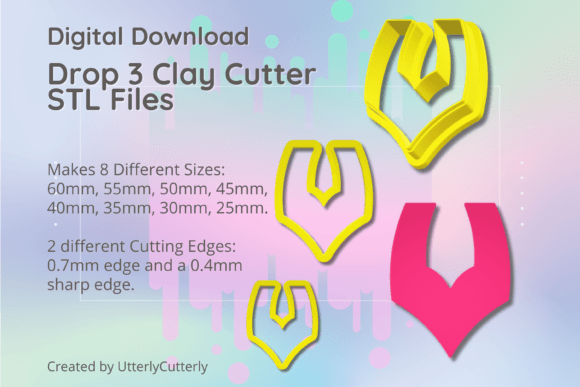
The Clay Cutter STL File - Drop 3 represents a focused iteration in digital fabrication assets designed specifically for polymer clay artisans, cookie decorators, and jewelry makers. Unlike generic shape files, this drop-shaped design bundle addresses specific production needs through engineered cutting edges and scalable sizing. For professionals and serious hobbyists utilizing FDM or resin 3D printing, the value of an STL file lies not merely in the aesthetic silhouette but in the functional geometry that dictates print success and material performance. This digital download provides a comprehensive suite of eight distinct sizes and two specialized edge profiles, allowing creators to maintain workflow consistency without relying on physical inventory.
Functional Geometry and Edge Profiles
The primary differentiator for the Clay Cutter STL File - Drop 3 is the inclusion of two distinct cutting edge architectures within the same geometric footprint. Understanding the mechanical difference between these profiles is essential for selecting the correct tool for specific media. A single blade thickness rarely serves both delicate jewelry work and culinary applications effectively; this bundle mitigates that limitation through dual-profile engineering.
Standard Wall Configuration
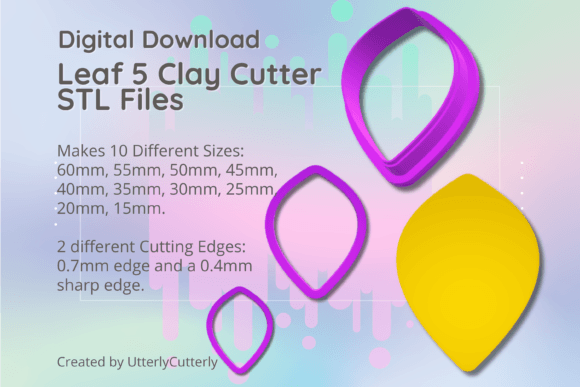
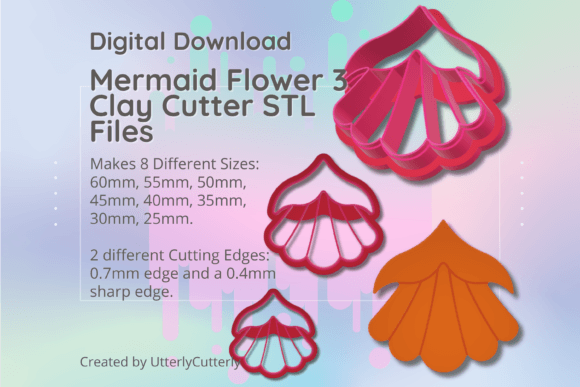
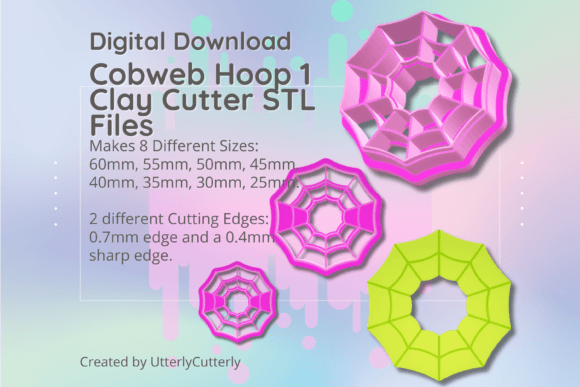
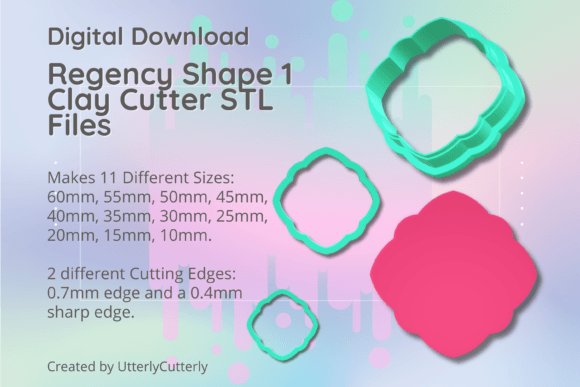
The first profile features a 0.7mm wall thickness with a 3mm base and a total height of 12mm. This specification offers structural rigidity during the pressing motion. The 0.7mm edge is robust enough to withstand repeated use with firmer clays or doughs without deforming, yet thin enough to provide a reasonably clean release. This profile is generally recommended for:
- Polymer clay earrings where durability of the cutter is prioritized over razor-sharp precision.
- Cookies and fondant decorations where a slightly rounded edge is acceptable after baking or drying.
- Barrettes and hair accessories requiring thicker clay slabs.
- Users printing with standard 0.4mm nozzles who want to ensure reliable layer adhesion on the cutting wall.
Sharp Edge (SE) Configuration
Files abbreviated as "SE" in this pack utilize a 1mm support wall tapering to a 0.4mm cutting edge. This design separates the structural integrity of the cutter from the cutting interface. The wider 1mm upper wall prevents flexing during compression, while the reduced 0.4mm contact point minimizes drag and distortion on soft materials. This profile is critical for high-detail work where edge definition determines the final product quality. It performs best with soft polymer clays, gum paste, or when creating pendants that require minimal post-processing sanding. Users should note that printing the SE version requires precise flow rate calibration to prevent under-extrusion at the 0.4mm tip.
Size Scalability and Production Versatility
Versatility in digital fabrication often correlates directly to size availability. The Clay Cutter STL File - Drop 3 includes eight incremental sizes ranging from 25mm to 60mm (measured from the longest ends). This graduated scaling supports several professional workflows that single-size cutters cannot accommodate.
For jewelry designers, the 25mm, 30mm, and 35mm variants serve as earring components, while the 40mm and 45mm sizes function as statement pendants or brooches. Having mathematically consistent proportions across these sizes allows for cohesive collection development. In culinary contexts, the larger 50mm, 55mm, and 60mm cutters transition seamlessly into cookie and biscuit production. This cross-disciplinary utility maximizes the return on investment for the digital asset, as the same design language applies to both wearable art and edible goods.
Furthermore, the incremental 5mm stepping between sizes facilitates nesting and layering techniques. Creators can produce framed designs or tiered clay builds by combining multiple sizes from this single pack, reducing the need to source complementary shapes from disparate designers.
Printability and Slicing Considerations
A significant advantage of sourcing the Clay Cutter STL File - Drop 3 as a digital asset rather than a physical product is the ability to optimize print parameters for specific printer hardware. These files are designed with manufacturability in mind, featuring a 3mm thick base that ensures adequate bed adhesion and reduces warping—a common failure point for tall, narrow prints.
When slicing these files, users should consider the following technical adjustments to maximize utility:
- Layer Height: For the SE (Sharp Edge) variants, a layer height of 0.12mm or lower is recommended to preserve the 0.4mm cutting geometry. Standard wall versions tolerate 0.2mm layers without significant performance loss.
- Infill: 100% infill is mandatory for all cutter types. Hollow walls lack the compressive strength required for clay work and will delaminate under pressure.
- Material Selection: PLA is sufficient for most polymer clay and fondant applications. However, for food-safe cookie production, users must verify their filament’s safety certification and consider PETG or specialized food-safe resins, keeping in mind that material shrinkage rates may alter final dimensions slightly.
- Orientation: Print with the cutting edge facing up to avoid support structures contacting the functional surface. The 3mm base provides adequate surface area for direct bed adhesion without brims in most cases.
Embossing Compatibility and Material Thickness
An often-overlooked specification in cutter design is embossing line clearance. Files in this pack featuring embossing details have lines set at 10.5mm tall. Given the total cutter height of 12mm, this leaves 1.5mm of clearance above the embossed feature. This dimension is not arbitrary; it establishes a minimum material thickness requirement.
To achieve clean embossing without bottoming out or distorting the clay slab, users must condition their material to exceed 1.5mm thickness before cutting. Attempting to use these cutters on thinner sheets will result in incomplete impressions or structural weakness in the finished piece. This specification makes the Clay Cutter STL File - Drop 3 particularly suitable for medium-to-heavy gauge projects rather than paper-thin veneers. Professionals should measure their conditioned clay slabs with calipers prior to production to ensure compatibility with this 10.5mm embossing threshold.
Evaluating Long-Term Workflow Value
Digital assets differ fundamentally from physical tools in their longevity and adaptability. Physical cutters degrade, break, or become unavailable; STL files remain perpetually reproducible. The Clay Cutter STL File - Drop 3 integrates into a sustainable production model where broken tools can be replaced in hours rather than weeks. For small business owners managing inventory, this eliminates storage concerns and supply chain dependencies.
The weekly release schedule mentioned by the provider suggests an active development pipeline. For creators building a brand around specific aesthetics, accessing regularly updated, stylistically consistent files reduces design friction. Rather than spending hours modeling basic shapes or vetting inconsistent free files, professionals can allocate time to finishing, assembly, and marketing. The drop shape itself is a foundational geometric form that pairs well with organic textures, metallic finishes, and seasonal themes, ensuring the asset remains relevant beyond trending cycles.
Practical Limitations and User Expectations
While the Clay Cutter STL File - Drop 3 offers substantial utility, prospective users should maintain realistic expectations regarding digital fabrication. Print quality is entirely dependent on user hardware and calibration. A poorly tuned printer will produce rough cutting edges regardless of file quality, necessitating post-processing sanding that negates the benefit of precision-designed STLs.
Additionally, the 0.4mm SE edge, while excellent for cutting, is inherently more fragile than the standard wall. Users applying excessive lateral force or twisting motions during demolding risk snapping the fine edge. Proper technique—straight vertical compression and release—is required to preserve cutter lifespan. Finally, as this is a digital download, there is no physical quality assurance prior to purchase. Users must validate their own print settings against the provided specifications before committing to large production runs.
For makers seeking precise, scalable, and reproducible cutting tools, this bundle delivers functional engineering alongside aesthetic design. By understanding the distinctions between edge profiles, respecting embossing clearances, and optimizing print parameters, users can transform these STL files into reliable production assets that support both creative exploration and commercial output.