Triangle Hair Barrette Clip Clay Cutter STL Guide
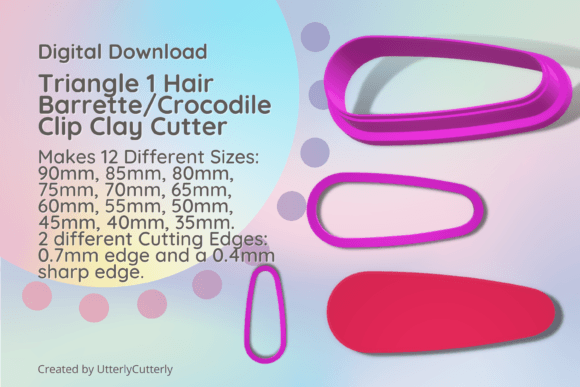
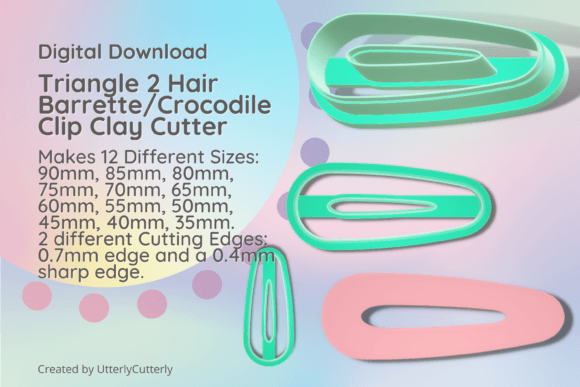
Creating geometric jewelry and precise fondant decorations often comes down to having the right tools for the job. The Triangle Hair Barrette Clip Clay Cutter is a digital STL file bundle designed specifically for 3D printing, allowing makers to produce custom cutting tools at home. Rather than relying on mass-produced metal cutters that come in limited sizes, this digital download provides twelve distinct dimensions and two specialized edge profiles. Whether you are crafting polymer clay earrings, styling hair accessories, or decorating baked goods, having immediate access to these files means you can curate a toolkit that matches your exact creative vision without waiting for shipping.
Digital Flexibility for Makers and Entrepreneurs
For small business owners and professional creators, inventory management is a constant balancing act. Physical tools take up space and capital, whereas a digital library of STL files offers infinite scalability. This specific bundle supports commercial agility by providing a comprehensive size range from 35mm to 90mm. If a client requests a miniature triangle stud earring one day and an oversized statement cuff the next, you can print the exact cutter needed within minutes.
This flexibility extends beyond just size. The inclusion of two distinct cutting edge types allows professionals to adapt their production based on the material being used. Polymer clay requires different handling than cookie dough or fondant. By owning the source files, entrepreneurs can also experiment with printer settings to optimize durability and sharpness, ensuring that every product leaving their studio meets a consistent quality standard. This level of control is difficult to achieve with generic, store-bought tools that may dull quickly or lack ergonomic considerations.
Understanding Edge Profiles for Different Materials
Not all cutting tasks require the same blade geometry. This STL pack addresses that nuance by offering two specific cutter variations, each serving a unique purpose in the making process. Understanding when to use each type is essential for achieving clean results across various mediums.
- Standard Wall (0.7mm): This version features a 0.7mm wall thickness with a 3mm thick base and a 12mm height. It is robust and durable, making it ideal for thicker clays, cookie dough, or fondant where structural integrity of the cutter is more important than razor-sharp precision. The wider wall helps prevent warping during printing and provides a comfortable grip during use.
- Sharp Edge (SE): Abbreviated as SE in the file names, this variation includes a 1mm support wall leading to a fine 0.4mm cutting edge. Like the standard version, it has a 3mm base and 12mm height. This profile is engineered specifically for polymer clay jewelry where crisp, clean lines are paramount. The sharper edge reduces drag and distortion when cutting softer conditioning clay, resulting in less post-processing sanding time.
Both designs maintain a consistent 12mm height, which is a deliberate choice for ergonomics and functionality. For users working with embossing details, note that any embossing lines are set at 10.5mm tall. This specification indicates that the cutter performs best with clay sheets thicker than 1.5mm to ensure the design transfers fully without bottoming out.
Educational Value and Skill Development
For educators, workshop leaders, and beginners, this digital bundle serves as more than just a tool; it is a learning resource. Teaching students about scale and proportion becomes tangible when they can physically hold a 35mm cutter against a 90mm one. The incremental sizing—ranging through 65mm, 70mm, 75mm, 80mm, and 85mm—allows learners to visualize how slight changes in dimension affect the overall aesthetic of a piece.
Beginners often struggle with the transition from digital design to physical object. Using pre-tested, reliable STL files removes the frustration of failed prints or poorly designed tools, allowing new makers to focus on mastering clay techniques rather than troubleshooting CAD models. For hobbyists exploring 3D printing for the first time, these cutters offer excellent practice prints. They are relatively fast to produce, use minimal filament, and provide immediate, functional feedback on printer calibration and layer adhesion.
Sizing Specifications and Project Planning
Selecting the correct size is critical for both jewelry assembly and culinary presentation. The cutter size is measured from the longest ends of the triangle, ensuring accurate scaling. Having twelve options available eliminates the guesswork often associated with freehand cutting or modifying existing tools.
- Micro & Small (35mm – 50mm): Ideal for delicate stud earrings, ring tops, charm components, and small fondant accents on cupcakes.
- Medium (55mm – 70mm): Versatile sizes perfect for standard dangle earrings, pendant bases, bracelet links, and medium-sized cookies.
- Large & Statement (75mm – 90mm): Best suited for bold hair barrettes, wide cuffs, large pendants, and decorative pastry elements.
This graduated sizing system encourages experimentation. A creator might start with a 60mm cutter for a prototype, realize the design needs more presence, and immediately print a 75mm version for comparison. This iterative process is fundamental to developing a unique style and refining product offerings.
Technical Considerations for Successful Printing
While these files are designed to be easily 3D printed, achieving optimal results requires attention to detail. All cutters in this collection are tested before release, but individual printer performance varies. When printing the Sharp Edge (SE) variants, consider using a smaller nozzle diameter or adjusting flow rates to ensure the 0.4mm tip forms correctly. Layer height also plays a role; finer layers will produce a smoother cutting surface that requires less sanding.
The 3mm thick base included in both designs serves a dual purpose. Structurally, it prevents the cutter from flexing under pressure, which is crucial when working with stiff clay or dough. Ergonomically, it provides a flat surface for the thumb or palm, reducing hand fatigue during long production sessions. This thoughtful design element highlights the difference between a generic shape and a tool engineered for actual use.
Expanding Your Creative Toolkit
This triangle barrette bundle is part of a broader ecosystem of digital maker resources. New STL files are added to the store weekly, allowing users to build a cohesive library of complementary shapes. Curating custom cutter combos becomes simple when you have access to a growing catalog of tested designs. For example, pairing these triangle cutters with coordinating arch or circle files can lead to complex, multi-part jewelry assemblies that stand out in a saturated market.
Ultimately, the value of this digital download lies in its adaptability. It empowers consumers to become producers, transforms hobbyists into skilled artisans, and gives professionals the efficiency they need to scale. Whether your priority is cost savings, creative freedom, or technical precision, having the ability to manufacture your own high-quality tools on demand changes the way you approach every project. By understanding the specific attributes of these cutters—from edge geometry to size increments—you can make informed decisions that elevate your craft and streamline your workflow.